Roofing, siding, windows, gutters, and storm damage restoration – every exterior service an Buffalo home needs, from a family-owned contractor with over 20 years in the field.
Perfect Exteriors of Minnesota, LLC is a licensed roofing, siding, window, gutter, insulation, and storm damage contractor serving Buffalo, MN and surrounding Wright County communities.
Operating from our Monticello office 12 miles west on US-55 since 2002, we serve Buffalo homeowners, HOA boards, and commercial property owners across the city without travel surcharges or metro-area dispatch delays.
With a median construction year of 1993 – the oldest housing stock in the Wright County communities we serve – Buffalo is a city where exterior replacement is an active, ongoing need across every neighborhood. If your Buffalo home has its original exterior from any decade before 2010, a professional inspection is overdue.
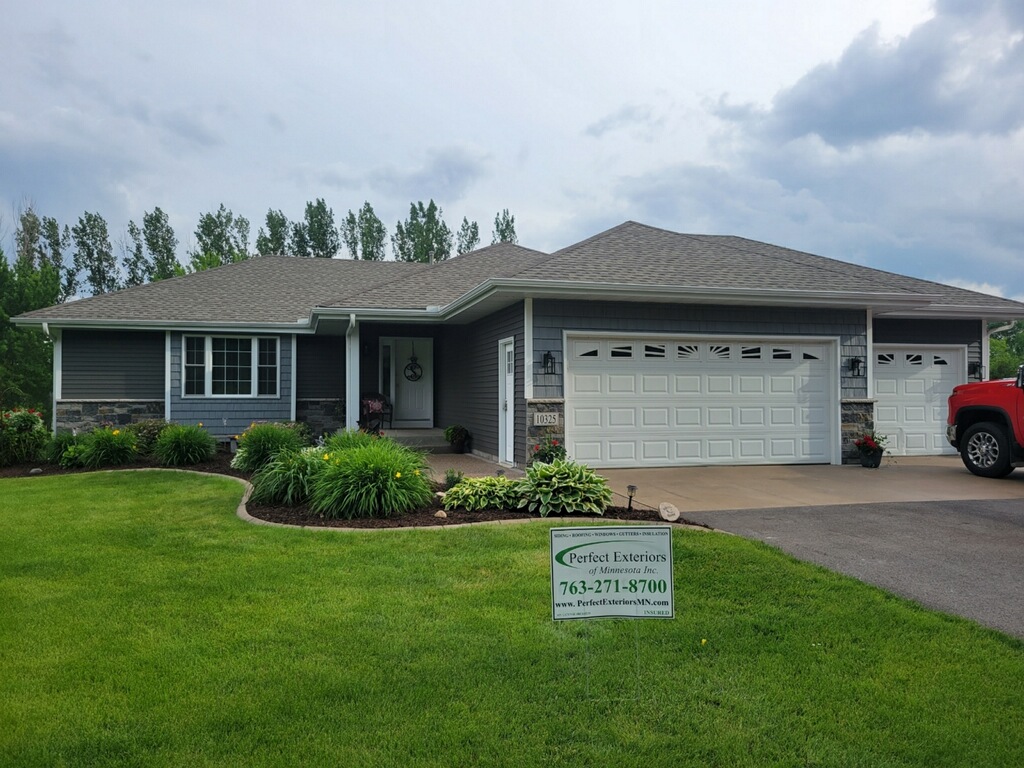

Residential and commercial roofing for Buffalo homes and businesses. With a median construction year of 1993 and meaningful pre-WWII housing inventory, Buffalo has active roofing replacement demand across every neighborhood – from the older homes near Buffalo Lake and Lake Pulaski to the subdivisions along the city’s US-55 and MN-25 corridors.
Asphalt shingles cover the majority of Buffalo's residential roofs across all housing eras - from the older homes near downtown and Buffalo Lake to 1990s and 2000s production subdivisions. Homes built in the mid-1990s through mid-2000s carry shingles at or approaching the end of their rated 25 to 30 year manufacturer warranty. Homes from the 1970s and 1980s are on their second or third asphalt cycle. As a TAMKO Pro Diamond Contractor, Perfect Exteriors installs dimensional and Class 4 impact-resistant shingles from the TAMKO Titan XT series, with ice and water shield standard on all eaves, valleys, and penetrations.
Brands: TAMKO Titan XT, TAMKO Stormfighter Flex
Cedar shake roofing complements the architectural character of Buffalo's older homes in the downtown and lakefront neighborhoods - particularly the craftsman and traditional-style houses near Buffalo Lake and Lake Pulaski built between the 1920s and 1960s. Hand-split cedar shakes deliver a thick, deeply textured profile appropriate for homes with historic character. Both shake and sawn shingle options require Minnesota-appropriate fire-rated underlayment assemblies and a counter-batten ventilation system for long-term performance in Wright County's freeze-thaw climate.
Metal roofing is a strong long-term choice for Buffalo homeowners replacing a roof for the second or third time who want to eliminate future replacement cycles. Standing seam steel and aluminum panel systems carry manufacturer lifespans of 40 to 70 years and shed Minnesota's heavy snow loads efficiently. For Buffalo's lakefront properties on Buffalo Lake and Lake Pulaski - where higher home values, longer ownership timelines, and property investment motivation align - metal is consistently worth pricing as a permanent solution. Snow retention systems are available for homes near entries, driveways, or walkways where controlled snowmelt matters.
Full roof system installation for new construction and complete tear-to-deck replacements throughout Buffalo. Every installation includes decking inspection and repair as needed, synthetic underlayment, ice and water shield at eaves, valleys, and all penetrations, drip edge, ridge vent, and properly flashed transitions at chimneys, skylights, and pipe boots. Permit applications are filed with the City of Buffalo. Buffalo's older housing inventory means decking repair and structural assessment are more commonly needed here than in newer cities - Perfect Exteriors documents every deck condition finding in writing before installation begins.
Free roof inspections are provided with every project estimate, with no obligation to proceed. Inspections document shingle granule loss, bruising, flashing condition, ridge and valley integrity, ventilation performance, and any signs of hail or wind damage. Buffalo's housing age distribution means inspection findings range widely - from hail damage on 1990s shingles to deteriorated flashing on 1960s homes near the lake. Because we are 12 miles away in Monticello, post-storm inspections can be scheduled quickly after Wright County hail events, ahead of the adjuster backlog.
Perfect Exteriors installs and replaces commercial roof systems for Buffalo businesses, county facilities, healthcare campuses, and industrial operations. As Wright County's seat, Buffalo has a substantial commercial and institutional base - including county government facilities, the healthcare corridor along US-55, and retail and industrial development at the US-55/MN-25 corridor. Flat and low-slope commercial buildings require TPO, EPDM, or modified bitumen systems depending on building age, occupancy type, and replacement budget. Being 12 miles from Monticello, we can schedule commercial site assessments without the travel delays affecting metro contractors.
Buffalo's housing stock includes approximately 10% attached townhomes and duplexes, plus a meaningful multifamily rental inventory reflecting the city's role as a regional employment and service center. HOA boards and property managers require a contractor who can handle large scopes with phased scheduling and minimal resident disruption. Perfect Exteriors coordinates directly with HOA boards, provides per-building cost breakdowns for reserve fund documentation, and delivers complete association insurance records. Being 12 miles away on US-55 makes site visits, storm response, and phased project management practical for Buffalo HOAs.
Exterior cladding replacement across all of Buffalo’s housing eras. Buffalo’s housing age diversity means siding replacement needs range from failed vinyl on early-2000s subdivisions to original wood siding on 1950s and 1960s homes near the lake – with every material type and condition in between.

Vinyl siding is the dominant cladding on Buffalo's 1980s, 1990s, and early 2000s housing stock, installed across the subdivisions that expanded the city outward from the downtown core and lake neighborhoods. Builder-grade vinyl from those eras is now 20 to 40 years old - showing UV fade, joint separation, panel warping, and compromised moisture management behind the cladding. Current-generation vinyl is significantly more UV-stable, thicker, and more impact-resistant than the original product on most Buffalo homes. Insulated vinyl adds closed-cell foam backing that improves wall-area thermal resistance and comfort in rooms along north-facing walls through Wright County's heating season.
LP SmartSide engineered wood siding is a natural fit for Buffalo's older homes near Buffalo Lake and Lake Pulaski, where the character of natural wood suits the neighborhood aesthetic but the maintenance demands of original wood siding have become burdensome. LP's zinc-borate SmartGuard treatment provides long-term moisture and biological resistance independent of surface coating condition. For Buffalo homeowners replacing original wood or hardboard siding on mid-century homes, LP SmartSide delivers a permanent, low-maintenance wood-look result at a cost well below fiber cement or cedar alternatives. Panels are pre-primed and field-painted for any color selection.
Brand: LP Building Products SmartSide
Steel siding is the most hail-resistant cladding available for Minnesota homes - a significant consideration in Wright County, where summer hail events regularly generate insurance claims. Steel panels do not dent under hail impacts that would damage aluminum or crack vinyl, and they resist the thermal expansion and contraction that causes vinyl to warp in Minnesota's temperature extremes. Concealed-fastener systems from EDCO carry one of the strongest manufacturer warranties in residential cladding. For Buffalo lakefront properties or any home with a strong reinvestment motivation, steel is worth pricing for a real long-term cost comparison against vinyl.
Brand: EDCO Steel Siding
Fiber cement siding provides the visual character of wood while resisting rot, fire, insects, and moisture. James Hardie manufactures HardiePlank in an HZ5 formulation specifically engineered for cold-climate markets like Wright County. Fiber cement is particularly well-suited for Buffalo's older lakefront and downtown homes, where an architectural siding material fits the neighborhood and a Class 1 fire rating with long-term moisture resistance adds genuine value. Factory-painted ColorPlus finishes eliminate field painting and extend repaint intervals significantly.
Brand: James Hardie HardiePlank HZ5

Energy-efficient window replacement across all of Buffalo’s housing eras. From aluminum-framed single-pane windows in pre-1980 homes to failed-seal double-pane units in 1990s and 2000s subdivisions, Buffalo’s housing age diversity means window replacement is active across every neighborhood type.
Double hung windows are the most common window style across Buffalo's residential stock, found across every construction era - from 1970s and 1980s colonial and split-entry homes to 1990s and early 2000s production homes. Both sashes operate independently, enabling flexible ventilation and interior glass cleaning. Vinyl-framed, double-pane units with Low-E coating and argon gas fill represent a substantial performance improvement over the aluminum-framed or builder-grade double-pane units found in most Buffalo homes built before 2005.
Sliding windows suit the wide, low-profile openings found in Buffalo's ranch-style and split-level homes from the 1960s through 1980s. Single-slide and double-slide configurations are available. Without cranks or hinges, sliding windows have fewer mechanical failure points over their service life. Many of Buffalo's mid-century homes still have their original aluminum-framed single-pane sliding windows - a replacement that delivers dramatic energy performance improvement with minimal visible change to the home's exterior character.
Bay and bow windows project outward from the wall plane to create an interior alcove and increase natural light. In Buffalo, bay and bow windows are particularly popular in lakefront homes on Buffalo Lake and Lake Pulaski, where light, water views, and street presence are worth prioritizing. Bay configurations use a fixed center pane flanked by two angled operating units; bow configurations use four or more panels in a gradual curve. Structural header modification is typically required to support the projection.
Casement windows hinge on one side and swing outward via a crank, pressing the full sash perimeter against a compression seal when closed - giving casements among the best thermal performance of any operable window type. This is a meaningful consideration in Buffalo where the heating season runs from October through April. Buffalo's lakefront homes frequently specify casements on water-facing elevations where both thermal performance and the ability to catch lake breezes in warm months are valued.
Picture windows are fixed, non-operable glass units that maximize light and unobstructed views. In Buffalo, picture windows are the natural choice for lakefront homes on Buffalo Lake and Lake Pulaski, where maximizing the water view is the primary design objective. They are also a strong choice for great rooms and living rooms in any Buffalo home where natural light and visual connection to rear yards or wooded lots are priorities. Because they have no moving parts, picture windows deliver the best thermal performance and lowest maintenance requirements per unit.
Seamless aluminum gutter systems for Buffalo homes. With Buffalo Lake, Lake Pulaski, and numerous wetlands and drainage corridors throughout the city, proper foundation drainage is a higher-stakes system in Buffalo than in many Wright County communities. Older gutters on the city’s pre-2000 housing stock are in active failure across multiple neighborhoods.

Perfect Exteriors installs seamless aluminum gutter systems fabricated on-site, eliminating the joints along horizontal runs where sectional systems most commonly fail. In Buffalo, where Buffalo Lake, Lake Pulaski, and numerous wetlands and drainage corridors create elevated drainage demands on residential lots, correctly sized and pitched gutters are a meaningful foundation protection investment. The city's high water table in low-lying areas near the lakes makes gutter performance a higher-stakes system in Buffalo than in many Wright County communities. Available in 5-inch and 6-inch K-style profiles with a full color range to match the home's fascia.
Gutter guard systems cover the gutter channel to prevent leaves, seeds, and organic debris from reducing flow capacity. Buffalo's tree canopy - particularly the mature oaks, maples, and cottonwoods in the lakefront neighborhoods and older subdivisions - produces heavy fall leaf loads heading into winter. Clogged gutters entering the freeze season contribute directly to ice dam formation along the eave. Micro-mesh guard designs filter fine debris including cottonwood seeds, maple helicopters, and oak debris. Buffalo's heavily treed lakefront and older neighborhood properties benefit most from premium micro-mesh guard systems given the debris variety and year-round organic load from established tree canopy.
When a hail or wind event hits Buffalo, most homeowners navigate the insurance claim process for the first time. We know how Wright County storm damage is assessed, how carriers define functional vs. cosmetic damage, and how to document your property so the claim reflects the actual scope of loss. And because we are 12 miles away in Monticello, we can be on-site before the adjuster backlog builds.
Insurance adjusters assess storm damage against carrier-defined criteria for functional vs. cosmetic damage. What appears significant from the ground - dented gutters, cracked siding, surface granule loss on shingles - may be evaluated differently by an adjuster than by a contractor who climbs the roof and documents the damage pattern systematically using carrier-standard methods. Perfect Exteriors provides free post-storm inspections with written reports and photographs, is available to accompany your adjuster on-site during the claim inspection, and can provide supplemental documentation to support a re-review if your initial claim is denied. For Buffalo homeowners with older homes where pre-existing wear interacts with storm damage, clear documentation distinguishing storm-caused damage from age-related deterioration is especially important to building a strong claim file. Being 12 miles away in Monticello, we can reach Buffalo often the same day after a storm event.
Severe wind events, summer microbursts, and winter ice storms can cause structural roof damage requiring immediate action to prevent water infiltration and interior damage. Perfect Exteriors is based 12 miles away in Monticello and can respond to emergency roof damage in Buffalo faster than any contractor dispatching from the Twin Cities metro. For Buffalo's older homes, where structural members may have accumulated age-related wear, rapid response reduces the risk of cascading interior damage from a breached roof assembly. Emergency repairs include securing lifted or missing shingles, temporary tarping of breached deck areas, and stabilizing damaged sections. All emergency work is documented in writing for inclusion in the overall insurance claim file.
General market ranges for a typical Buffalo single-family home. Final pricing depends on home size, age, material selection, and project scope. Older Buffalo homes may require additional structural and deck work. All estimates are free.
| Service | Typical Material | Price Range |
|---|---|---|
| Roofing | ||
| Asphalt Shingle Installation | TAMKO Titan XT, TAMKO Stormfighter Flex | $8,000 – $19,000 |
| Cedar Shake Installation | Natural cedar shakes/shingles | $18,000 – $38,000 |
| Metal Roof Installation | Steel / aluminum panels | $14,000 – $33,000 |
| New Roof Installation | All materials | $8,000 – $23,000 |
| Roof Inspection | - | Free with estimate |
| Commercial Roofing | TPO, EPDM, modified bitumen | $7 – $19 per sq ft |
| Multifamily Roofing | All materials | $10 – $21 per sq ft |
| Siding | ||
| Vinyl Siding | Standard & insulated vinyl | $9,500 – $21,000 |
| LP SmartSide (Engineered Wood) | LP Building Products | $13,500 – $27,000 |
| Steel Siding | EDCO steel panels | $15,000 – $30,000 |
| Fiber Cement Siding | James Hardie HardiePlank | $15,000 – $30,000 |
| Windows | ||
| Double Hung Windows | Vinyl, double-pane Low-E | Contact for estimate |
| Sliding Windows | Vinyl, double-pane Low-E | Contact for estimate |
| Bay & Bow Windows | Vinyl / composite | Contact for estimate |
| Casement Windows | Vinyl, double-pane Low-E | Contact for estimate |
| Picture Windows | Vinyl, double-pane Low-E | Contact for estimate |
| Gutters | ||
| Seamless Gutter Installation | Aluminum K-style | $1,400 – $3,200 |
| Gutter Guards | Micro-mesh / reverse-curve | $600 – $2,000 |
| Storm Damage & Restoration | ||
| Insurance Claim Assistance | - | No charge |
| Emergency Roof Repair | All roofing materials | $500 – $3,000 |
* Price ranges reflect Wright County market averages for 2025. Older Buffalo homes may require additional structural, deck, or moisture barrier work affecting final cost. Contact Perfect Exteriors of Minnesota for a free, project-specific estimate in Buffalo.
If you think you’ve got roof damage or need a roof replacement, don’t delay. Make ours the first number you call! Request a free, no-obligation inspection and estimate at 763-271-8700. Our office is open to receive your call Monday through Friday from 9 AM to 5 PM, plus extended weekday hours and Saturdays by appointment. You can also get in touch with us through our contact form.
"*" indicates required fields